
Do the opposite
I’d like to tell you that the idea came out of my deep and serious understanding of some human principle, but really I was just kind of desperate.

Context
A thing often happens to me when I’m facing long stretches of time in which there are many things it would be nice or useful1 for me to do (the dishes, for one, but also so many work texts and emails, unfinished craft projects, a pile of clean laundry unfolded and slowly wrinkling on my floor) but none of them a) feels like a clear priority, or b) promises something interesting/fun/pleasurable/fresh/curiosity-piquing.23 Feeling overwhelmed both by all there is to accomplish and by how to decide where to start, I often choose instead to scroll the phone.
While in the moment a screen does provide some relief for times when the executive function4 bits of my brain have abandoned me, the long-term impact is fairly corrosive. I end up feeling a kind of content hangover, like my brain has been pickled in chipper voices saying “I don’t know who needs to hear this but…” I don’t really want to be swiping anymore, but anything else feels so hard. I know the desire to create is within me—I have saved SO MANY short-form videos of art projects that I must want to make art—but the idea of disengaging from the screen to create feels like wading through molasses.
Anyway it’s terrible and I’m experimenting with ways to break the pattern.5 The other day my experiment was to try being bored.
I’d like to tell you that the idea came out of my deep and serious understanding of some human principle, that I made the choice because of my brilliant intellect, but really I was just kind of desperate. One morning, the endless thumb-flick of delight-chasing started to feel unstimulating, the distraction less distracting, the escape unsatisfying. In that moment, with my self soothing tool worn out and my to do list no less daunting, I flailed for another option. The one I came up with was “be bored.”
In hindsight I do have kind of a neat intellectual rationalization for this. In Laban/Bartenieff Movement Analysis there is this theme of exertion/recuperation. The idea is that our bodies, as living things, are in a constant cycle of exertion and recuperation. The rhythmic back and forth is natural. It’s part of how life moves. The most obvious exertion/recuperation cycle is physical exercise and rest—we do squats on Tuesday and let our muscles recover on Wednesday—but there are many kinds of exertion, and for every different kind of exertion there is a corresponding way to recuperate. To put it simply, doing the opposite of the thing that has been exhausting you is what will make you feel better. Sometimes that’s sitting still, but a lot of the time it’s not.6 In the case of my current predicament, the thing exhausting me was having too many things to do and too little decision-making juice with which to tackle them. The opposite? Too little to do and no decisions to make! The opposite of overwhelmed is bored.
I put the phone down (already a victory!) and went to sit on the porch, because if I was going to be bored I might as well do it surrounded by birdsong and tinkling wind chimes. Once seated, I sat. In the absence of something to watch or listen to or read or make, my mind wandered all over the place, and I let it. I thought such inconsequential thoughts as “Car noise is so irritating but also I like going places so probably I can’t be mad that other people are going from a place on one side of my house to a place on the other side of my house” and “My friend is in Idaho I’ve never been to Idaho I wonder if they make a good potato taco there” and “It’s kind of hot today.”
After not too long the thoughts became ideas. Newsletters it would be interesting to write, juicy exercises for the classes I’m teaching, knitting projects and such. I had been bored for not twelve minutes and already my creative, energized self was coming back on line.
I noticed I was thirsty and went in for a glass of water. On the way I glanced at my bookshelf and noticed the spiral-bound notebook of paper pockets where I keep all the cards and notes people have written to me over the years. I felt a pang of sadness, remembering that some few of those pockets contained affectionate words from people who used to be very important to me and aren’t in my life anymore. Right on the heels of that sadness came an idea: what if I made a collage out of the cards from ex-friends?7 I could turn those painful memories into something beautiful, translate an ache into a make. Would it alchemize the feelings, help me process them? I decided to find out.
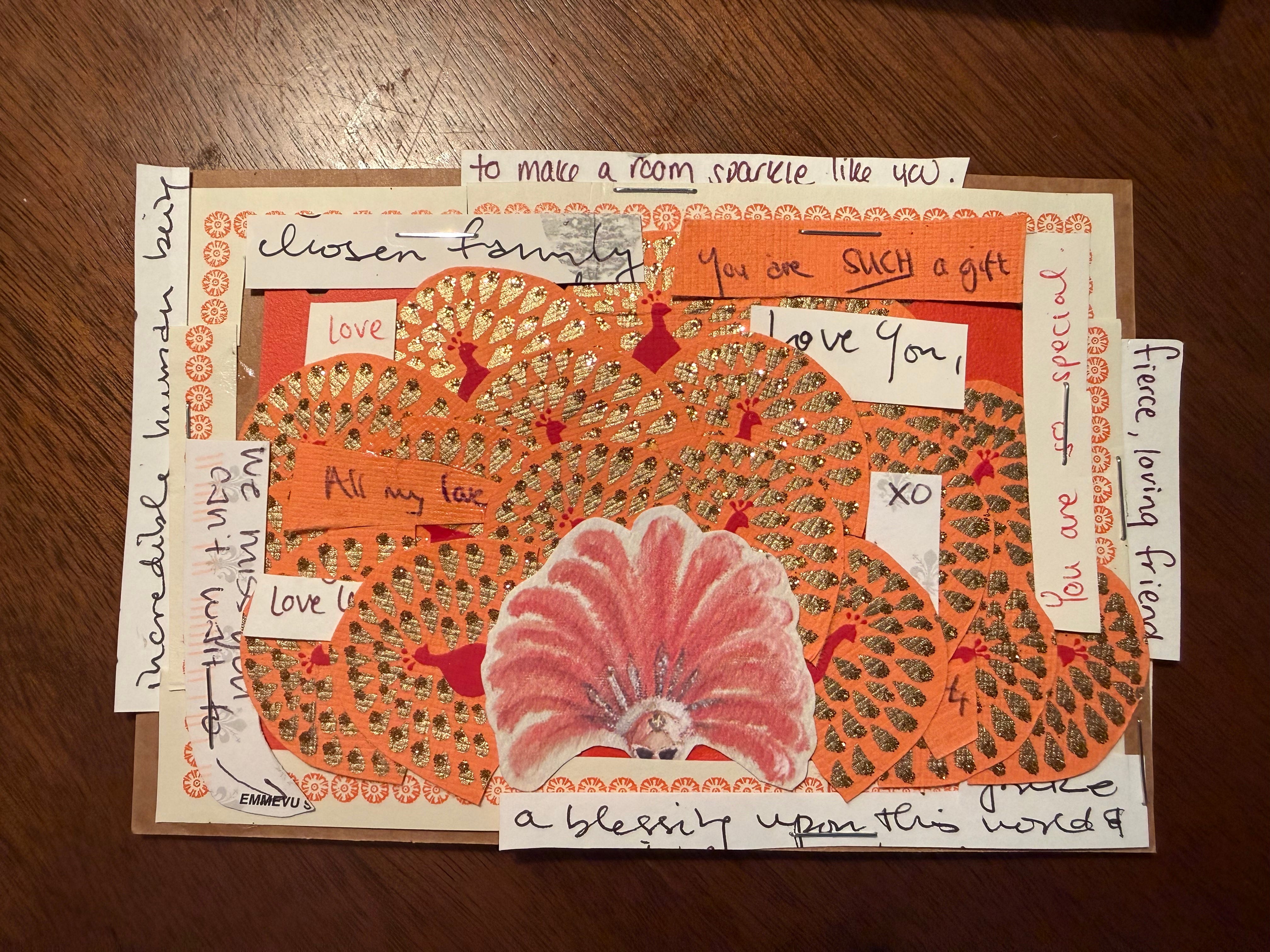
I made a collage.8 The piece is the size of a postcard. In the center at the bottom there is the face of a woman peeking out from behind a floral-printed border. She’s wearing sunglasses and a giant, red-feathered, sparkly headdress of the showgirl variety. Radiating out from the headdress are layers and layers of paper peacocks with golden plumes. Tucked around the border are some of the more tender snippets of text, kind words in the handwriting of people who hurt me. They say things like “incredible human being” and “to make a room sparkle like you,” “you are SUCH a gift” and “You are so special” and “a blessing upon this world.” They say “fierce, loving friend” and “we miss you” and “chosen family.” Tucked in amongst the peacocks are the sign-offs from every card: “love,” “love you,” All my love,” “love love,” “xo.”
It’s not my most beautiful or interesting collage, not the neatest or the most conceptually bold, but I’m grateful for it. I’m grateful to have cleared the people who I feel sad about out of my correspondence keepsake place. I’m grateful that in this format, with these sentiments cut up and prettily recontextualized, I can look at their words and feel pride alongside the pain. I’m grateful that the making of it felt good, that I spent that hour (only an hour!) making instead of scrolling.
The next time that something about the world or being in it feels intolerable, and you reach for your phone to soothe the suffering, I hope that the universe sends you some small alternative. I hope for you (for all of us) ever more options to feel okay, ever more possibilities for what our minds could do and be.
Did something in here resonate with you? Forward this email to a friend!
Want to have this kind of conversation about something you’re grappling with? Book a coaching call with me.
The next round of my very easeful 7-week course, Bricolage: Tools for a Non-religious Spiritual Practice, hasn’t been scheduled yet. If you’re interested, respond to this email and tell me what timing would work for you!
Stuff
Fundraisers for the families of people murdered by ICE in the past week: Johan Sebastián and Lorenzo Salgado Araujo.
I keep stumbling across things to do with our long-distant cousins the whales and how they evolved to go back into the ocean while we stayed on land. This piece taught me that sometimes belugas are called “canaries of the sea” because they’re so vocal, and that’s delightful. Belugas are so cool guys.
I keep getting so much out of what Rebecca Nagle is making these days. This one is about the precedent for undeclared wars, which is shockingly and not shockingly way older than I ever would have guessed.
This site turns the weather into Rothko paintings, because why not.
I have been learning more about deer lately; maybe that’s why I found these fairly unassuming photos of their beds sort of quietly stirring?
You will note that I don’t say things I “should” do, because it would only obscure the reason why a thing is appealing and important and would also make me feel badder.
Intellectually I understand that it feels very good to water the garden and drink water and stretch and clean out my inbox. I just somehow can’t remember that very real fact when I’m on the before side of the task.
Yes, I also understand that these ways my brain moves are some of the things folks describe as ADHD. That’s helpful because it’s connecting me to other people whose brains move similarly and I get to benefit from both their strategies for managing it and their thoughtful conceptualizations of it. I’m learning new words! That’s nice. Exhibit A:
executive function, noun: the cognitive processes that make up a person’s ability to organize thoughts and activities, prioritize tasks, and make decisions.
This in itself is a way out, actually. Novelty, it turns out, is the very best motivator for a brain like mine. If something is new and shiny, choosing to pursue it feels easy. It is for this reason that trying a new organizational system, rearranging all the furniture, looking at a thing and deciding I could probably make one and why not try are all things that genuinely light me up. Thus, if a choice other than screen is an ~*~experiment~*~ rather than a strategy for doing what’s hard, I’m much more likely to choose it.
Shout out to Laban/Bartenieff Movement Analysis and my beloved teacher Alexandra Beller for seeding this framing in me.
This term feels so harsh and so final, not completely right. I still don’t know how to talk about friendships that used to be and aren’t now. Do you?
I’m calling it “Thank you so much for being just exactly who you are,” which is a sentence from one of the cards that made my heart twist briefly and violently when I read it.