
Less and less and less
When we are in the depths of burnout so much feels impossible. Until, with enough time and space, one day it doesn’t.

Context
When we moved into our little house in November, my housemates and I had a fire in the fire pit out back to commemorate our new beginning. We had grand dreams for a new life in the woods—the ritual we’d make, the connection to the land we’d feel, and the ease it would all be wrapped up in. But we were all so, so tired. The last few years have kicked all of our asses in one way or another, and the logistics of our move up here was the cherry on top. Finding a moment when all three of us were at the house and able to gather around a fire was in and of itself a gargantuan task, and so our little ritual wasn’t elaborate or pre-planned. On the way outside to meet my housies, I rooted through my apothecary, waiting to be called out to by its contents, scanning for a volunteer to be an offering for the fire.1 Luckily, a little tin of birch bark2 stepped up. At the fireside, I distributed fragments of the papery tree-skin and invited each of us to feed it to the flames while offering a prayer or intention for the new life we’re beginning.
When it was my turn to speak, I found myself saying something before I’d thought it through. I said “I am committing to have a moment with this land every day.”
If you know me at all, you know that there are few things I like less than a routine. There’s almost nothing I do every day short of waking up and eating something at some point. The idea of committing to a daily practice should, based on my history, be abhorrent. And yet, that’s what I said by the fire and when I said it I knew it was something I would do, however imperfectly.
It has indeed been imperfect. Some days I forget, though less often than I would have predicted. Other days, when the existential exhaustion is too much, the idea of walking up the hill behind the house and into our yard is insurmountable. Many days I have found myself readying for bed only to remember that I’ve forgotten to be with the land.
In those moments, I try to reach for something small. Sitting on my front porch3 and smoking a cigarette,4 I leave my phone in my pocket and try to spend three full breaths paying attention to the sound of the brook across the street rushing after a day of rain, or the light sparkling on the snow. It’s not easy even to make three breath’s worth of space without my mind monkeying about, swinging itself up and away through metaphorical trees of preoccupation. Many days, all I could figure out how to do was look at the small tendril of vine that sneaked in between the posts of the porch’s railing.
“Hello,” I thought when I first saw it. It was notable not only for its small encroachment on my personal space, but also because it was a long finger of plant reaching far beyond the tree where it seemed rooted. At the end that had made its way to the porch, it had stopped being quite so vine-like and had instead curled back on itself, making a sort of whimsical loop. “Hey,” I imagined it saying back as it bobbed gently in the breeze.
I was so depleted then that this brief hello was all I could manage for a while. The breeze had become colder by several degrees by the time our relationship escalated. “Hello. Who are you?” I thought one day, and set about identifying the plant. I used the app on my phone, which registered the nondescript vine and essentially said “You’re kidding, right?”5 I thought that was fair enough and put my phone away. It was more days still of offering nothing more than the barest of greetings before I roused enough to make the effort again. This time I traced the vine back to where it wrapped around the tree, noted its bright red berries like pearled couscous rubies dotting its more mature parts. It’s unusual for there to be berries like that in winter, which made an ID possible. The plant is a variety of bittersweet that is notoriously hardy and vicious, twining itself around everything in its path and taking down even large trees in its strangling grip.
Our greetings were warier after learning all that, clouded as our relationship had become by the knowledge that I would at some point have to kill it. Still, I hadn’t the energy for evisceration, and so it stayed a hallmark of my daily land practice. On one particularly memorable night, I looked up into the net of vines and saw in the light reflecting onto them from the street lamp something like a glistening spider’s web, blown up to human scale. Beautiful, and apt in its ominous portent. The berries and the tendrils and the web would have to go some day, lest they kill a tree that might fall on my already precarious porch or one of our precious6 cars.
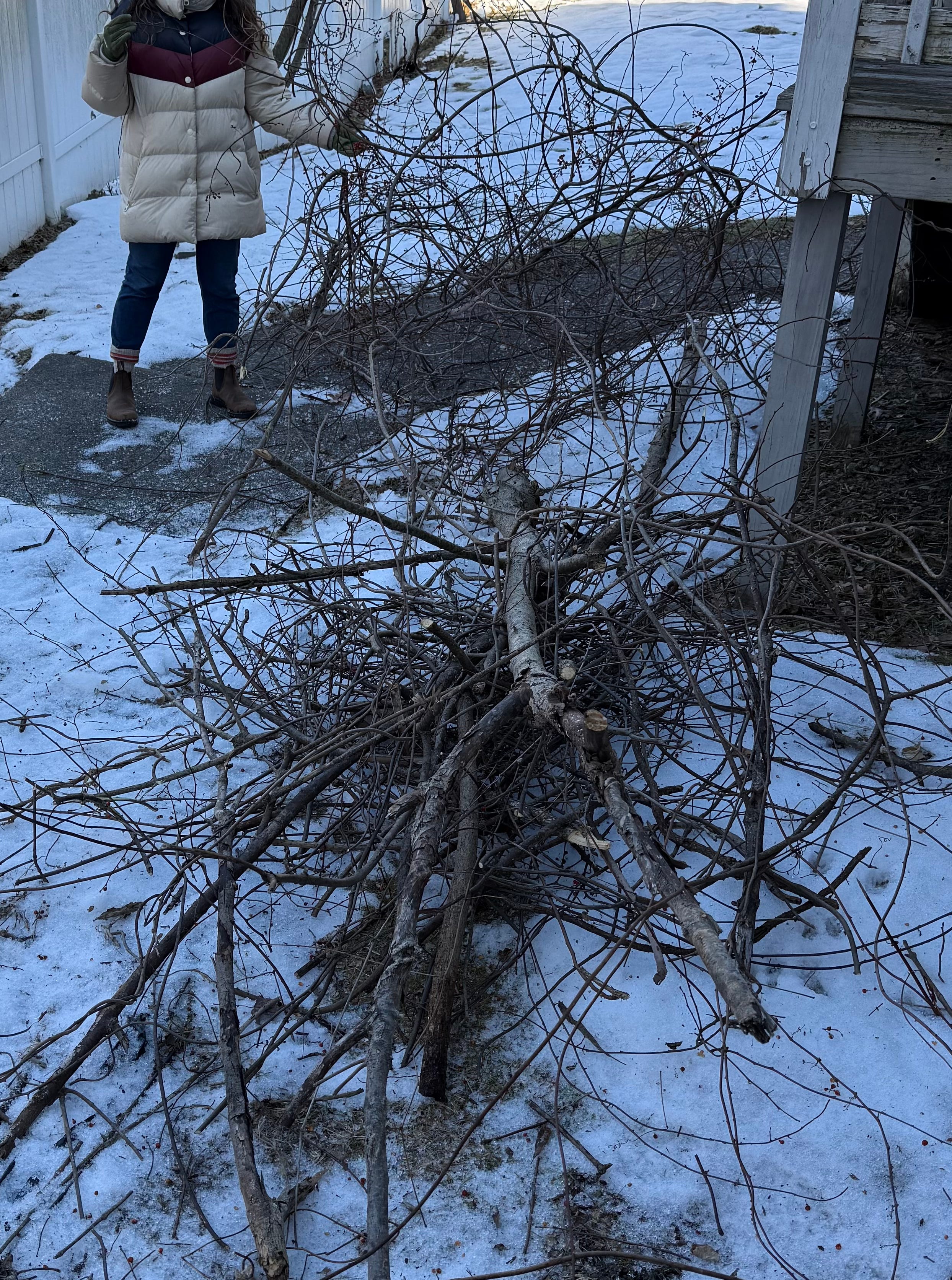
Today, friends, was that day. We had our housemate brunch/business meeting as usual this morning, an event that always concludes with some kind of land practice. Kristin was eager to address the threat of domestic and vehicular peril posed by our berry-ful friend, and so we all donned gardening gloves, wielded saws and shears, and went out to take a look. Feeling tired, I had committed only to investigating the scope of the problem, but soon we were clipping and sawing, tugging thick vines and pointing out the roots to each other so we could cut as close to the ground as possible. It was incredible how vast the plant’s network had become from so few rooting spots. Having cut the plant off at the ankles, it would have been impossible not to try to tug away its constricting arms, and so we did that too. We grabbed hold of dangling plant bits and heave-hoed until they came free of the tree in giant tangles. While dragging the resulting pile up the hill, Kristin said “It’s like hair!” and when I looked up she did seem to be a kind of Rapunzel, trailing about 50 feet of gnarled locks.
By the end, we’d spent maybe 45 minutes and had cleared more than any of us expected to. What’s more striking is that we all felt so much better after. Over eggs that morning we’d all talked about having a hard time in one way or another, struggling to crawl out from under the emotional and logistical weight of this present moment. But something about the combination of things required for this task of culling was alchemical. The physical labor of pulling at thick vines, the problem-solving of finding their roots to be snipped, the fresh air in our noses, and the satisfaction of task completion combined to be much more than the sum of those parts. Like the freshly freed trees, our load was lightened, too.
Tonight, sitting at my computer after a meeting, I found myself with the energy to work through a backlog of life admin. I turned to my inbox—a place I have been all but entirely avoiding since, if I’m honest, July—and suddenly I was on a culling spree here too. I archived whole pages of unread emails, knowing that I would miss something I should have responded to but knowing, too, that I would be more likely to respond tomorrow if there wasn’t a whole mountain of messages there making me cranky and avoidant. I unsubscribed ruthlessly to newsletters I never read and updates no longer relevant now that I live somewhere new, feeling with each click a small parcel of burden tumbling away from me. I’d gotten maybe halfway through7 the digital buildup when I felt this essay scratching at the peripheral thresholds of my mind, connections occurring and descriptions assembling themselves. I felt, for the first time in months, able to write.
The time when I couldn’t muster the energy to do more than say hello to the only plant that was directly in my field of vision feels—all at once and also in a painstakingly incremental way—so far away tonight. I’m so grateful.
When we are in the depths of burnout so much feels impossible. Until, with enough time and space, one day it doesn’t. I hope that when that day comes for each of us, we can use whatever energetic possibility emerges to cut away what’s dead and deadening, yank the strangling vines from our internal worlds and stretch ourselves wider in their wake. May it be so for you too, when you’re ready.
Did something in here resonate with you? Forward this email to a friend!
Want to have this kind of conversation about something you’re grappling with? Book a coaching call with me.
The next round of my very easeful 7-week course, Bricolage: Tools for a Non-religious Spiritual Practice, hasn’t been scheduled yet. If you’re interested, respond to this email and tell me what timing would work for you!
Stuff
You will want to be on the list for my brilliant friend Richael’s newly rekindled substack.
Delight of a human, my dear one Nora, wrote this luxe and nostalgic romp of a piece about (among other things) heart-shaped bathtubs in the Poconos. Go for the photos, stay for the prose and the strange history.
Abolish ICE art from Justseeds, because sometimes we need our grief and fury made beautiful.
This short, poignantly painful piece about talking to children about climate change was a beautiful gut punch.
Not that buying things can solve all our problems, but this project bag was my Christmas gift to myself and it has been a real quality of life improvement.
In spiritual practice class we talk about how an offering needn’t be anything fancy or particular. A good offering is something that is precious to you and/or something you know is precious to the thing you’re offering it to. Water is an offering. So is song and story.
Birch is a magical tree. It’s easy to see just by looking—its bright white or aged-paper yellow standing out against the grey-brown of its neighbor’s trunks. Birch is often the first thing to grow after the land has suffered a kind of trauma. When a fire razes everything to the ground, birch is the first to re-root there, as if to say “I am not afraid of the places where there has been pain. There will be something new here. I’ll get us started.”
This, an immeasureable blessing. Cannot recommend private outdoor space highly enough.
Another daily habit, but one I somehow feel shy about sharing. It’s good to remember that we all have our vices, I guess.
When this happens, the app usually returns a result of “dicots.” This frustrates my bestie Michael, so much that it’s become something of a bit in my circles to respond “it’s a dicot” whenever anyone muses aloud about what a plant might be.
Precious because we can’t afford to replace them, not because they’re in any way fancy.
If your email is in the half I haven’t gotten to yet, I hope you’ll forgive me.
There’s so much magic here - the unplanned commitment that led to sitting outside and saying hello to the vine, that led to identifying the vine as a potential danger. I’m glad some combination of you and your ancestors and spirit are looking out for you, and that things are feeling so much more possible 💜
love you dearly